Demonstrate advanced knowledge of and competence in the application of research methods and techniques.
Throughout my time in the program, I had the opportunity to work as a research assistant under Dr. Mahed Choudhury. For this research, we looked into the processes, drivers, and actors shaping wildfire policy. The goal of the project was to map and analyze the evolution of wildfire management and governance policy in BC. We did this by documenting lessons learned from major wildfire events, identifying drivers of wildfire policy change, and identifying key actors, rightsholders and stakeholders in wildfire policy change in BC. Working on the project greatly helped me to expand my knowledge and skillset in this program learning outcome as I was able to gain hands-on experience with a number of research methods. I was also given the opportunity to work directly on research ethics board applications and creating the necessary documents for that.
The first research method that I developed a new understanding of is policy analysis. For this research, I worked to analyze wildfire and disaster management policies in British Columbia from the last 100 years. Starting with the Bushfire Act of 1974, we characterized 4 phases of wildfire policy paradigms. The first is fire exclusion spanning from 1925-2002. This phase was defined by a top-down approach to wildfires where they were seen as something that needed to be, and could be, completely avoided. Next, is the second phase of fire exclusion from 2002-2010. Here, wildfire exclusion was still seen as both feasible and ideal but governments began to understand the importance of using community advisors, changing the governance mechanism to be more bottom-up. Then we have fire management from 2011-2020 where a large shift occurred. Wildfires were no longer seen as entirely preventable or avoidable, but rather something that the government needed to manage as best as they could. Lastly, there has been a shift to partner based fire management from 2021-now. This is where we begin to see a recognition of the importance of understanding and partnering with Indigenous communities for proper forest management. Together, these four phases illustrated how policy analysis can help identify long-term changes in both the substance of public policy and the governance approaches used to implement it.
The second research method I used was qualitative interviewing. I conducted interviews with former wildfire policymakers and policy analysts in British Columbia to explore whether their professional experiences aligned with the findings from our policy analysis. While the policy analysis provided a historical overview of formal policies, the interviews offered an opportunity to understand how these changes were experienced and interpreted by the individuals involved in wildfire policy development and implementation. The interviews allowed us to examine whether the transitions identified through the documentary analysis reflected the realities of policymaking in practice. This reinforced the value of using multiple research methods to examine the same issue. While the policy documents established a timeline of formal changes, the interviews provided additional context about the motivations, challenges, and experiences behind those changes.
Overall, the opportunity to work on this research helped me develop a stronger understanding of how policy analysis and qualitative interviews can complement one another. I learned that policy analysis is useful for identifying historical patterns, categorizing changes in government approaches, and examining how policy priorities evolve over time. Interviews, meanwhile, provide a deeper understanding of the human experiences and institutional contexts that help explain those changes. More broadly, this research demonstrated to me the importance of looking beyond the content of individual policies to consider the assumptions, governance structures, and relationships that shape public decision-making.
Articulate original ideas, arguments and observations through group work and presentations, and high-quality writing or artistic works.
Throughout the program, I had several opportunities to expand my skillset in relation to this program learning outcome. Many of the courses encouraged students to move beyond traditional academic writing and explore alternative ways of communicating complex ideas. These assignments allowed me to develop my ability to present research and arguments in ways that were both informative and visually engaging, while also considering how different formats can influence an audience’s understanding of an issue.
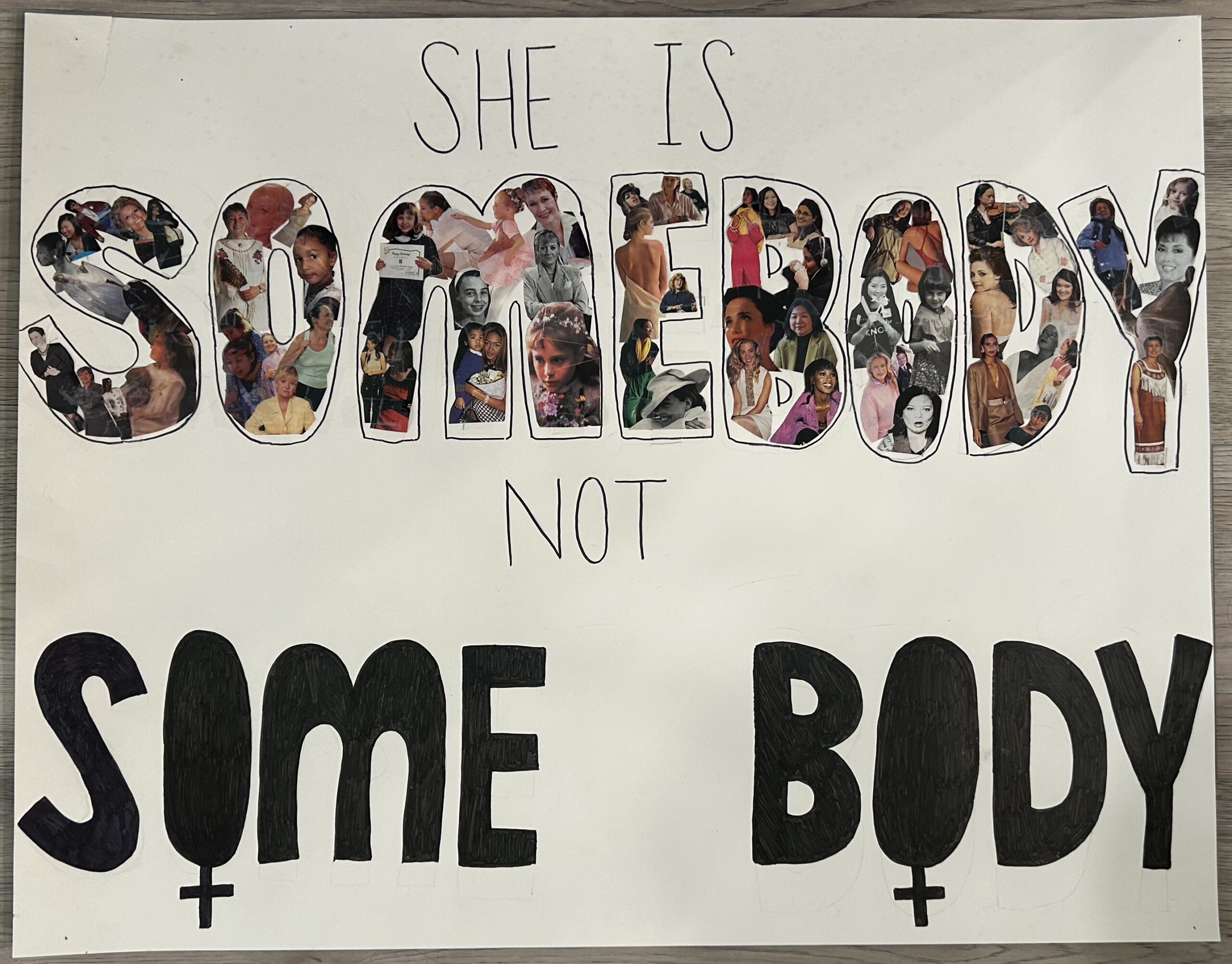
One example of this is one of the art projects I created in HRSJ 5140: Art, Media, and Dissent. The poster was centered around the message, “She is somebody, not some body.” Through the use of photographs and collaging, the poster communicated an argument about the objectification of women and the importance of recognizing women as whole individuals rather than reducing them to their physical appearance. Unlike a traditional academic assignment, this project relied primarily on visual imagery and a concise, impactful message to encourage reflection. It required me to consider how artistic choices, including the selection of images, composition, and wording, could communicate a social critique and evoke an emotional response from viewers. The project also demonstrated how creative expression can serve as a form of argumentation, allowing complex social issues to be communicated in ways that resonate with audiences beyond the classroom.
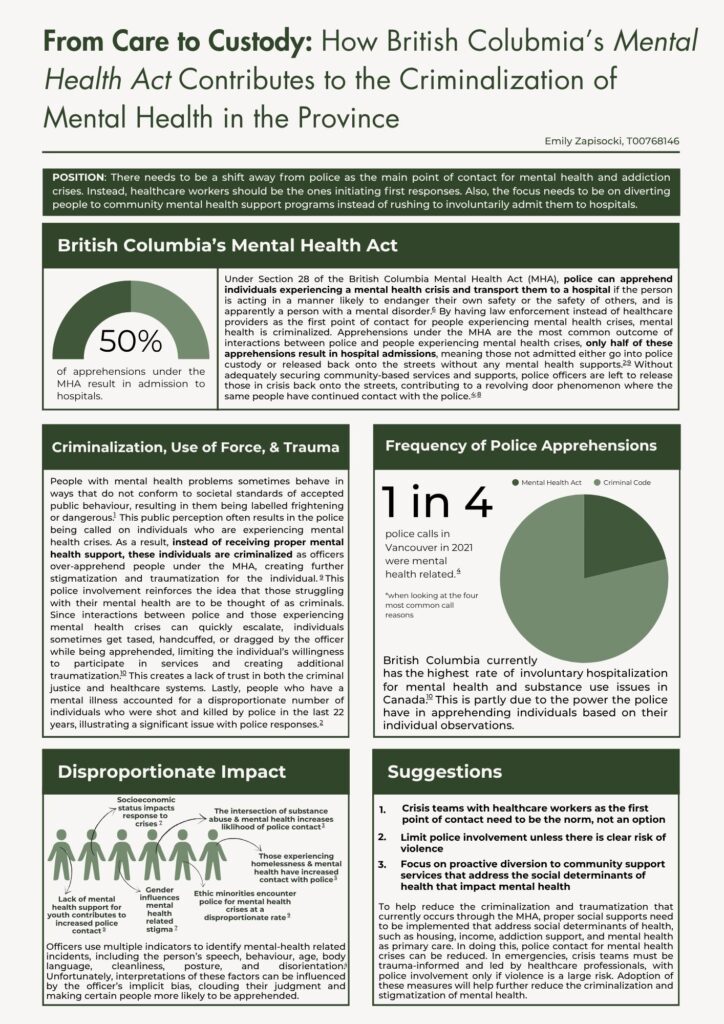
A second example is the policy brief infographic I created in HRSJ 5270: Social Determinants and Medicare. The policy brief examined how the British Columbia’s Mental Health Act contributes to the criminalization of mental health in the province. Rather than presenting my research solely through a traditional written policy brief, I used visual elements, statistics, and concise written analysis to communicate my argument. The infographic explored the relationship between mental health crises, police apprehensions, involuntary hospitalization, and the disproportionate impacts of the policy on marginalized communities. It also presented recommendations for shifting toward healthcare-led crisis responses and community-based mental health supports. This project challenged me to synthesize complex policy research into a clear and accessible format while ensuring that my central argument remained evidence-based. It strengthened my ability to communicate policy issues to a broader audience and demonstrated how visual communication can make research more engaging without sacrificing its analytical depth.
Creatively engage in finding solutions to issues of justice and fairness in contemporary society at a community, provincial, national, and/or global level.
This program learning outcome was largely met through my practicum. For my practicum I worked to support the development of a practical implementation plan for BCLI’s (British Columbia Law Institute) 2023 Communications Audit. Much of my practicum was self-guided, with my supervisor stepping in primarily when I requested assistance or feedback. This structure provided me with a significant degree of independence and allowed me to take ownership of the project. Rather than simply following a predetermined list of instructions and completing a task that was clearly laid out for me, I was responsible for critically assessing the task, identifying potential approaches, and determining how best to translate the findings of the Communications Audit into actionable recommendations. This required me to think creatively about the organization’s needs and consider solutions that were both practical and achievable. Having this level of responsibility pushed me outside my comfort zone, as I had to rely on my own judgment, adapt to challenges as they arose, and develop confidence in my ability to make informed decisions.
This experience also helped me understand how creative problem-solving contributes to addressing broader issues of justice and fairness in contemporary society. For an organization such as BCLI, effective communication is important to ensuring that its research, law reform recommendations, and other work reach the audiences who may benefit from them. By contributing to the implementation plan, I had the opportunity to consider how communication strategies could be improved to support the organization’s broader mandate and help make its work more accessible and impactful. This encouraged me to think about justice from an organizational and systemic perspective, recognizing that even seemingly small improvements in communication can contribute to greater awareness, understanding, and engagement with legal issues.
Ultimately, my practicum demonstrated the importance of approaching complex problems with creativity, flexibility, and critical thinking. I learned that developing effective solutions often requires moving beyond established approaches, evaluating the needs of different stakeholders, and considering how recommendations can be implemented in practice. The independence I was given allowed me to develop these skills while taking greater responsibility for the direction and quality of my work.
';